The Process Step by Step
1. The starting materials are prepared. Limestone is burnt at about 1000 °C and slaked with water, producing slaked lime.
CaCO₃ → CaO + CO₂ · CaO + H₂O → Ca(OH)₂
The “double-acid sulphate of potash” is heated until it glows. It loses water and sulphur trioxide, leaving potassium sulphate behind.
2 KHSO₄ → K₂S₂O₇ + H₂O → K₂SO₄ + SO₃
2. Potassium hydroxide solution forms in the mortar. Slaked lime, potassium sulphate and hot water react, with the evolution of heat, to form potassium hydroxide solution and gypsum.
K₂SO₄ + Ca(OH)₂ + 2 H₂O → 2 KOH + CaSO₄ · 2 H₂O
From 50 g each of the two salts, calculation gives 574 mmol of potassium hydroxide (32.3 g) and 287 mmol of gypsum (49.4 g); 383 mmol of lime remains in excess. This “magma” is placed in the flask.
3. On heating, the solution becomes ever more caustic. The water gradually evaporates, and the potassium hydroxide solution in the flask becomes more concentrated and hotter. The conditions for the next step therefore only arise in the course of the distillation and are most pronounced at the end.
4. The hot solution attacks the glass and dissolves out silicates. Soda-lime glass, of the kind available to Hahnemann, is attacked by hot potassium hydroxide solution; silicon dioxide passes into solution from the glass surface as silicic acid. The potassium sulphate in the mixture acts as a mediator here, because it brings poorly soluble metal oxides into solution.
SiO₂ + 2 H₂O → Si(OH)₄
How much dissolves depends strongly on pH and temperature: at pH 7 and 25 °C it is around 100 mg/l, at pH above 12 and 100 °C around 10,000 mg/l. Silicic acid is volatile with steam and rises with the vapour. Modern stills made of Duran glass release practically nothing; this is precisely why their distillate remains pure water.
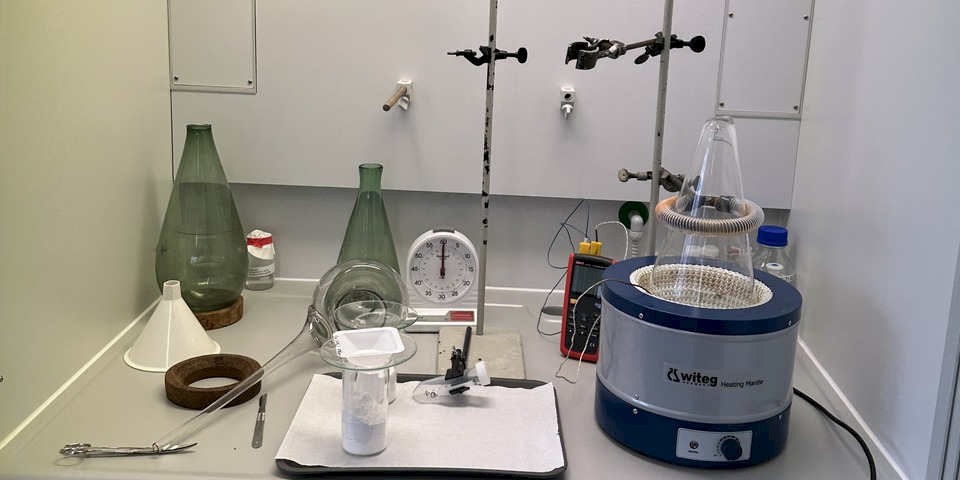
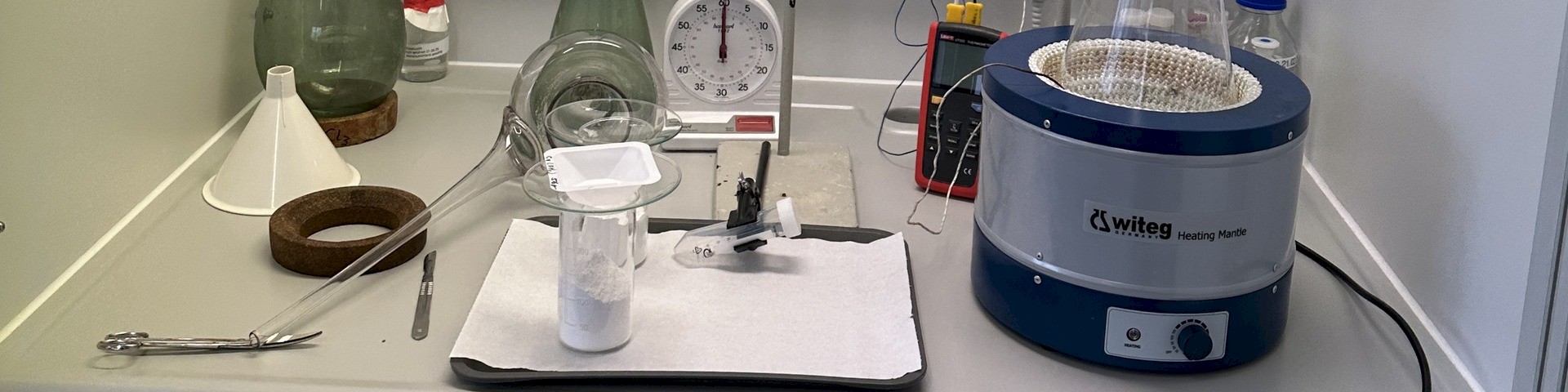
5. Protein drips back into the solution from the seal. The soaked pig's bladder is placed around the neck of the flask and the still-head set on top; part of the bladder lies against the inside and extends into the vapour space. Heated along with the glass, fats and proteins are released, creep along the glass surface and drip back into the flask. In the hot potassium hydroxide solution the proteins are broken down, producing ammonia, alongside which lower amines may also occur. This arrangement, with the sealing material on the inside, produces the largest amounts of ammonia: 60.6 mg/l in the final fraction, compared with 11.4 mg/l without the bladder.
6. Ammonia and silicic acid rise together. Both are volatile, pass with the water vapour into the still-head and run over the spout into the receiver. The salts in the flask — gypsum and excess lime — remain behind. This explains why Hahnemann's tests for sulphate and calcium were negative.
7. Ammonium silicate forms in the condensate. Ammonia reacts with water to form ammonium and hydroxide ions and keeps the pH above 9 to 10. In this range, the silicic acid remains deprotonated and in solution, rather than condensing into polysilicic acids; the solution remains clear.
NH₃ + H₂O ⇌ NH₄⁺ + OH⁻
2 NH₄OH + Si(OH)₄ → (NH₄)₂SiO₃ + 3 H₂O
8. The distillate remains stable, for the time being. The excess ammonia stabilises the dissolved silicates. If the solution is acidified or warmed, ammonia escapes and the liberated silicic acid polymerises into a gelatinous silica gel. This behaviour is consistent with the observation that, in one experiment using the historical apparatus, crystals precipitated in the first fraction after 24 hours of cooling; these dissolved again in alkali and gave a positive reaction for silicate.
What the fractions show: The ammonia content rises from fraction to fraction, because the seal remains hot for longer and the solution becomes more concentrated; the silicate values, by contrast, remain largely constant. Gentle heating in an oil bath produces markedly less of both than rapid heating, which confirms the sequence described above.