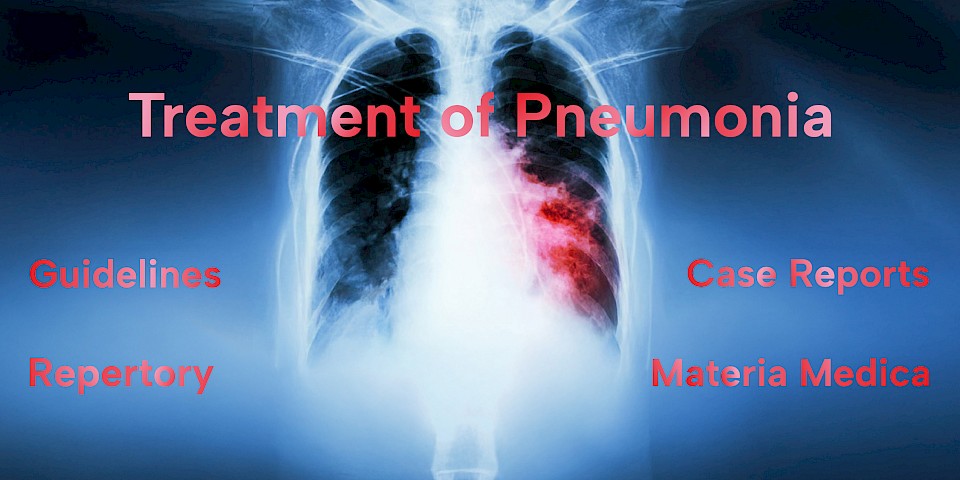
X-ray image of a lung. Above it, the terms: Treatment of Pneumonia, Guidelines, Repertory, Case Reports, Materia Medica.

The Homeopathic Pneumonia Project (HPP)

Homeopathic Treatment in the 21st Century: Guidelines, Materia Medica, Repertory, and Case Studies.

Project presentation

During the COVID-19 pandemic, two Austrian colleagues, Dr Tom Vogel and Dr Martin Wernhart, launched a very ambitious project.

The aim was to compile all referenced sources on the homeopathic treatment of pneumonia and/or pleurisy from the last 200 years and to link them to current clinical knowledge and practice.

The work was completed over a period of several years. The result is a reference work of exceptional quality with a special purpose. The English-language e-book is published as open source and is available to colleagues worldwide for free download.

The Constantin Hering Foundation supports this idealistic approach and the project due to its high-quality content and has obtained a licence from the authors for worldwide distribution.

First, the project is presented by the authors, followed by an interview. The download links for the free eBook “Pneumonia – A Synoptic Guide for Homeopathic Treatment 2.0” are located at the bottom of the page.

Authors

Dr. Tom Vogel, Dr. Martin Wernhart

Introduction

Pneumonia remains one of the most common acute illnesses with potentially lethal consequences.

Due to the wide range of anatomical structures involved, the symptoms, the possible pathogens and the severity, the mortality rate is highly variable, even with modern conventional medical treatment. Precise statistical figures cannot be determined, not least because of the high number of unreported cases. According to current WHO estimates, more than 100 million people fall ill with pneumonia every year. Between 1 and 1.5% of all hospital patients acquire nosocomial pneumonia, with a mortality rate of 30-70%.

There are 200 years of experience with classical homeopathy in the treatment of people with pneumonia, with some impressive successes even before the era of antibiotics.

Since 2020, with the onset of the SARS-CoV2 pandemic, the HPP has set itself the goal of compiling this experience and making it available to all interested homeopaths.

Project period

The project began in March 2020.

The e-book was completed in November 2025.

The first integration into homeopathic work software (JRep) took place in November 2025. Further integrations are planned.

The translation of the work into other languages (Russian, Spanish, Portuguese) has been in progress or is being pursued since 6/2025.

Methodology

  • Comprehensive homeopathic literature research, distributed in books, journals and articles in German and English, with corresponding references to achieve maximum literature transparency.
  • Summary of pneumonia-specific materia medica to avoid redundant information.
  • Compilation of the collected information into a repertory based on the pneumonia repertory by A. and D.T. Pulford
  • Creation of a comprehensive clinical introduction with details on pathophysiology, diagnostics, case management, etc.
  • Incorporation of modern findings in conventional medicine
  • Inclusion and creation of clinical scores and guidelines
  • Collection and compilation of historical and contemporary cases for treatment

Results

  • Book available as e-book and print-on-demand.
  • Pneumonia – A synoptic Guide for Homeopathic Treatment 2.0 – Clinical Guidelines, Materia Medica, Repertory and Case Reports, 837 pages.
  • Currently available in English (translations into various languages are planned).
  • The e-book "Pneumonia – A Synoptic Guide for Homeopathic Treatment 2.0" is available here for free download.
  • The homeopathic work software is available free of charge from JRep.
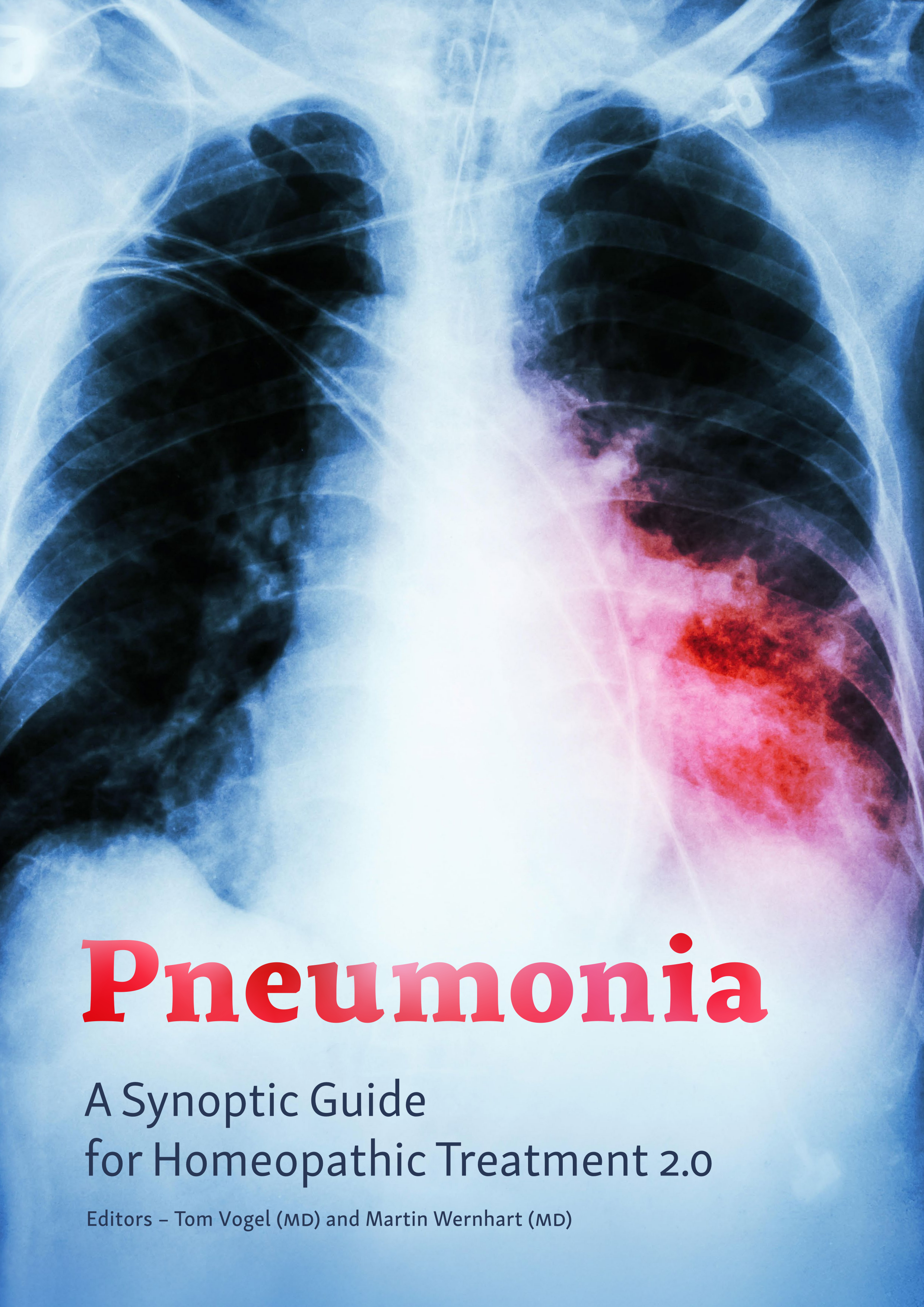
Book cover: Pneumonia - A synoptic Guide for Homeopathic Treatment 2.0

Discussion

  • The decision to produce the book in English is based, on the one hand, on the fact that the majority of the literature researched was originally written in English, and on the other hand, on the fact that English, as a global language, allows for wider international dissemination.
  • Attempting to create a work that is both compact and comprehensive requires compromises. The main focus was on collecting pneumonia-specific and clinically verified information from various authors. In this context, it is difficult to draw clear distinctions in borderline clinical cases (for example, bronchitis transitioning to bronchopneumonia).
  • To what extent the diagnostic selection of clinical signs and symptoms should be based solely on the results of homeopathic drug trials (traditionally: Homeopathic Drug Proving, HAMP) or also on insights derived from cured cases was not further differentiated by us. Accordingly, in the present work, all empirically collected data were left unchanged and attributed to the respective authors.

Conclusions

  • Homeopathy is an inexpensive and effective treatment option for pneumonia.
  • In times of increasing antibiotic resistance, supply shortages and/or viral pandemics, homeopathy can play an important role in global health.
  • The compilation of published homeopathic experience and its combination with modern medicine is an example of best practice literature.
  • Open source literature offers the opportunity to share and use knowledge worldwide, quickly and free of charge.

Highlights

  • Specific materia medica for 146 remedies
  • The most comprehensive pneumonia repertory currently available
  • 500 published homeopathic case reports
  • Concentrated experience in dosology
  • Modern guidelines for case history taking and case management
  • Useful information on additional treatments (e.g. fluids, oxygen, etc.)

Summary

The work "Pneumonia – A synoptic Guide for Homeopathic Treatment 2.0" summarises 200 years of experience in the homeopathic treatment of pneumonia and enriches it with modern clinical insights. This is what homeopathic practice can look like in the 21st century.

References

  • See the bibliography in "Pneumonia – A Synoptic Guide for Homeopathic Treatment 2.0".

Special thanks to the following experts and institutions for their contemporary contributions and appreciation of our work:

  • Tjado Galic and the Constantin Hering Foundation for Homeopathic Medicine® (Germany)
  • Ernst Wendt Foundation (Germany)
  • Pierre Schmidt Foundation (Switzerland)
  • Medical Association for Classical Homeopathy (Austria)
  • Prof. Dr. Carlos Campora (Argentina)
  • Dr. Andre Saine and the Team of the MMPP (Canada)
  • Prof. Dr. Michael Frass Dr. Burgi Meisl, Dr. Christoph Abermann (Austria)
  • Dr Hans-Jörg Hee (Switzerland)
Dr Tom Vogel
Dr Tom Vogel

Contakt Dr Tom Vogel

e-Mail: ordination@drvogel.at

Phone: +43 660 73 67 497

Website: https://drvogel.at

Dr Martin Wernhart
Dr Martin Wernhart

Dr Martin Wernhart

Interview with Dr Tom Vogel

The interview with Dr. Tom Vogel was conducted on 18 January 2026 by Tjado Galic on behalf of the Constantin Hering Foundation for Homeopathic Medicine®.

What were your personal motives for the project?

For over 20 years, I have been concerned with the question of which quality management criteria are relevant for homeopathic training and practice.

As a young doctor, I initiated and led the Gold Standard Case Study Project. This included literature research, expert interviews and a symposium – including an evaluation of frequent and/or serious sources of error in homeopathic training and practice.

... and for your colleagues in general?

At the beginning of the SARS-CoV-2 pandemic in March 2020, we simply wanted to compile the best possible information for the treatment of people with pneumonia.

As our work progressed, we found more and more works and data from 200 years (approx. 150 source works in total) on various topics relevant to high-quality homeopathic therapy in this area. We wanted to carefully review this material and compile it into a functional overview.

We also wanted to reflect as accurately as possible the progress made in treatment over the last 200 years (e.g. dosology, case management, etc.).

What was your approach to this pneumonia project?

At the outset, we did not realise how extensive the existing literature is and how much work would be involved in reviewing and compiling the information – ultimately, this project has required approximately 3,000 hours of homeopathic work alone. This does not include the time spent on graphic design, programming homeopathic software (integration into https://jrep.de), translation into various languages, and the worldwide presentation and distribution of the work.

How did you proceed?

1. Research of relevant sources

Research of relevant sources on clinical experience with pneumonia:
a. Extended literature research: Systematic review of Radar and Synergy (formerly McRepertory) using keyword searches
b. Additionally, experts were consulted on the literature, approximately 20–30 highly experienced practitioners
c. Essential information from Dr André Saine's Materia Medica Pura Project was provided to us by project manager Roland Methner
d. As well as other digital databases of historical literature

As a result, we identified 150 sources in homeopathic literature on the subject of pneumonia that contain information on clinical introduction, materia medica and repertories.

2. Case Studies

The next step was to comb through case studies in homeopathic journals. Around 500 cases, not all of which can be referenced in detail[1] , were nevertheless evaluated.

We first checked all information that was missing in the materia medica and repertories from a clinical perspective and supplemented it if it was of good quality. It was possible to find many clinical references that, on the one hand, turned out to be incorrect therapies and, on the other hand, provided astonishingly well-founded additional information.

As a result, this led to a more differentiated recording of symptom combinations for remedies and to the identification and weighting of key differential diagnostic remedy symptoms.
In this way, the material for Materia Medica and Repertory was compiled.


[1] The literature often consists of conference reports or anthologies that summarise the clinical information of many practitioners without naming them individually.

3. Clinical Guidelines

In addition, we have gradually collected further important topics for modern, high-quality training and practice and summarised the information in a separate section entitled "Clinical Guidelines". This includes comprehensive descriptions of the pathognomonic symptoms and progression of pneumonia, the specifics of case history taking and case management, in particular the key points of dosology, and other therapeutic measures (e.g. oxygen administration, fluid intake, etc.).

In order to ensure a guideline-compliant approach, it was also important to us to define modern decision-making criteria regarding the boundaries between outpatient and inpatient treatment as precisely as possible.

In doing so, we also reviewed historical data to determine when and how treatment was administered in order to reflect developments in treatment (e.g. the increasing use of higher potencies and more frequent doses in the acute crisis of pneumonia treatment).

This also required incorporating the current state of other medical and scientific knowledge.

From a homeopathic-holistic perspective, this also resulted in a critical look at conventional approaches, for example, the treatment of fever, the effects of pneumococcal vaccinations, and much more.

Looking back, how would you assess the overall effort involved?

The project developed into a comprehensive process, always guided by the guiding principle of what else could be valuable in order to cover the topic of "pneumonia treatment" in a professional and differentiated manner. The concept of the book developed as a "work in progress".

What is special about this concept?

First, we wanted to collect all the essential information on a clinical area and make it available in one place.

Our aim was to create a prototype for modern homeopathic clinical literature – analogous to corresponding modern works in conventional medicine.

The aim is to compile all specific materia medica information with as few duplications as possible.

This provides a repertory of clinical experience based exclusively on referenced sources.

This means that all repertory entries can be found in the materia medica and in the cases. This is unique.

We were able to demonstrate the development and special features of dosology – for example, low potencies were used at the beginning, then over time, medicines in higher potency ranges or in solution were applied instead of individual dry doses; in addition, application instructions for unconscious persons, infants and young children.

Pneumonia remains one of the most common causes of acute death worldwide, especially in children. The burden of disease remains high worldwide, not only in developing countries but also in Western industrialised nations, especially in the context of hospital-acquired pneumonia with multi-resistant germs. The material provides a good basis for promoting homeopathic research efforts on such a global health problem.

The vision behind this is to compile free information (open source) with all the tools for homeopathic practitioners (digital app) worldwide (analogous to the Cochrane Society in conventional medicine), instead of hoping for proceeds from sales, which usually cover only a very small part of the costs.

We are promoting a merger of national and international efforts to support the financing and implementation of such projects. In our case, support came from Austria, Germany, Switzerland and Argentina, among others.

How did you deal with the change in clinical terminology?

We tried to work out the clinical terminology used (from 200 years ago) as accurately as possible and list it in a glossary.

We also addressed the question of which terms could be translated into modern terminology (e.g. terms such as catarrhal pneumonia, typhoid pneumonia, etc.).

How did you come up with the special content presentation of the Materia Medica?

The starting point was Pulford's Pneumonia Materia Medica. Then Borland's work was included due to its more comprehensive pneumonia-specific presentations and clinical expertise, resulting in a total of about 30–35 drug preparations.

Additions from other sources were made in the order in which we found them, with only those items that were not already included being added. This ultimately resulted in information on 146 remedies.

What criteria did you use to evaluate the case studies?

Key considerations were

  • to present a realistic picture of clinical practice across the different time periods, including all errors, some of which were commented on by us,
  • to highlight gaps and shortcomings in the case presentations,
  • to preserve a large amount of information that is not documented anywhere else,
  • to provide fundamental practice material for education and continuing professional training,
  • to include referenced repertory entries from case studies only if they demonstrably achieved a curative effect,
  • to apply, as a matter of principle, the same approach to small remedies with limited information as to polychrests,
  • to identify and assign the clinical phases of pneumonia along with their characteristic features relevant to remedies.

How did you develop the repertory concept?

The basis of our repertory is Pulford's Pneumonia Repertory, which, according to Pulford, is based on the structure of Kent's Repertory.

Pulford included 28 remedies in his repertory and did not adopt all entries from Kent's repertory.

In the next step, all specific materia medica information was added to existing and new rubrics from the materia medica analysis, provided we found a clear source for the entry. This also applied to entries from Kent's Repertory.

We proceeded in the same way with the usable information from case studies.

We then checked current standard repertories (Synthesis, Complete Repertory, Murphy's Repertory, Knerr, etc.) again to see if there were any additional rubrics and remedy entries. Here, too, we only included information that could be clearly referenced by sources.

Which QM concepts were used for error correction?

All collected case reports were reviewed twice and repertorised to check whether all information could be found. Suggestions for the repertory were also developed and added.
The content of the clinical introduction was edited by a colleague from intensive care medicine with expertise in homeopathy.

The entire text was submitted to five highly experienced homeopathic colleagues for content review, including Dr Hans-Jörg Hee (CH), Dr Carlos Campora (ARG), Prof. Michael Frass (AUT), Tjado Galic (GER) and Dr. Andre Saine (CAN).

Living authors were presented with the information they had used for review and, where necessary, correction.

The English proofreading was carried out by a native American speaker.

Thank you very much for the interview and for this great work, which is now available to homeopaths worldwide.
Download the eBook

The eBook ‘Pneumonia – A Synoptic Guide for Homeopathic Treatment 2.0’ is available for free download here.

Download .pdf Download .epub