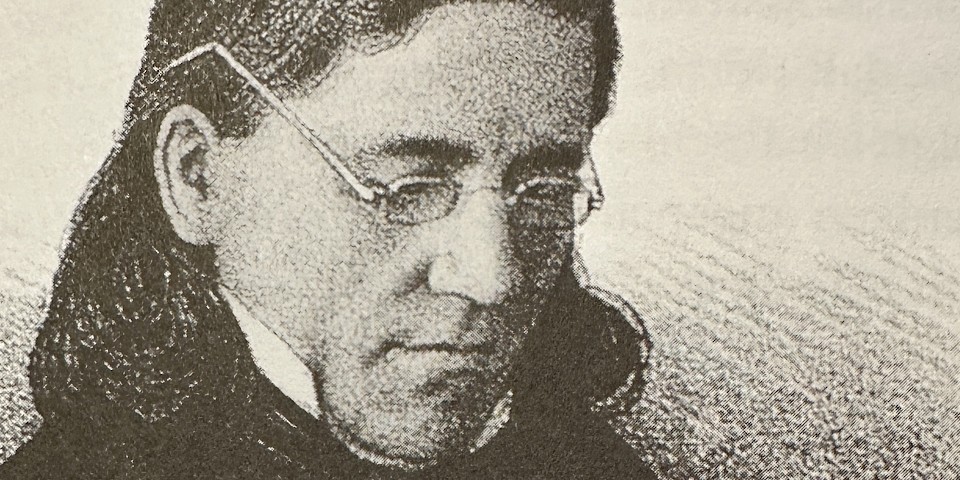

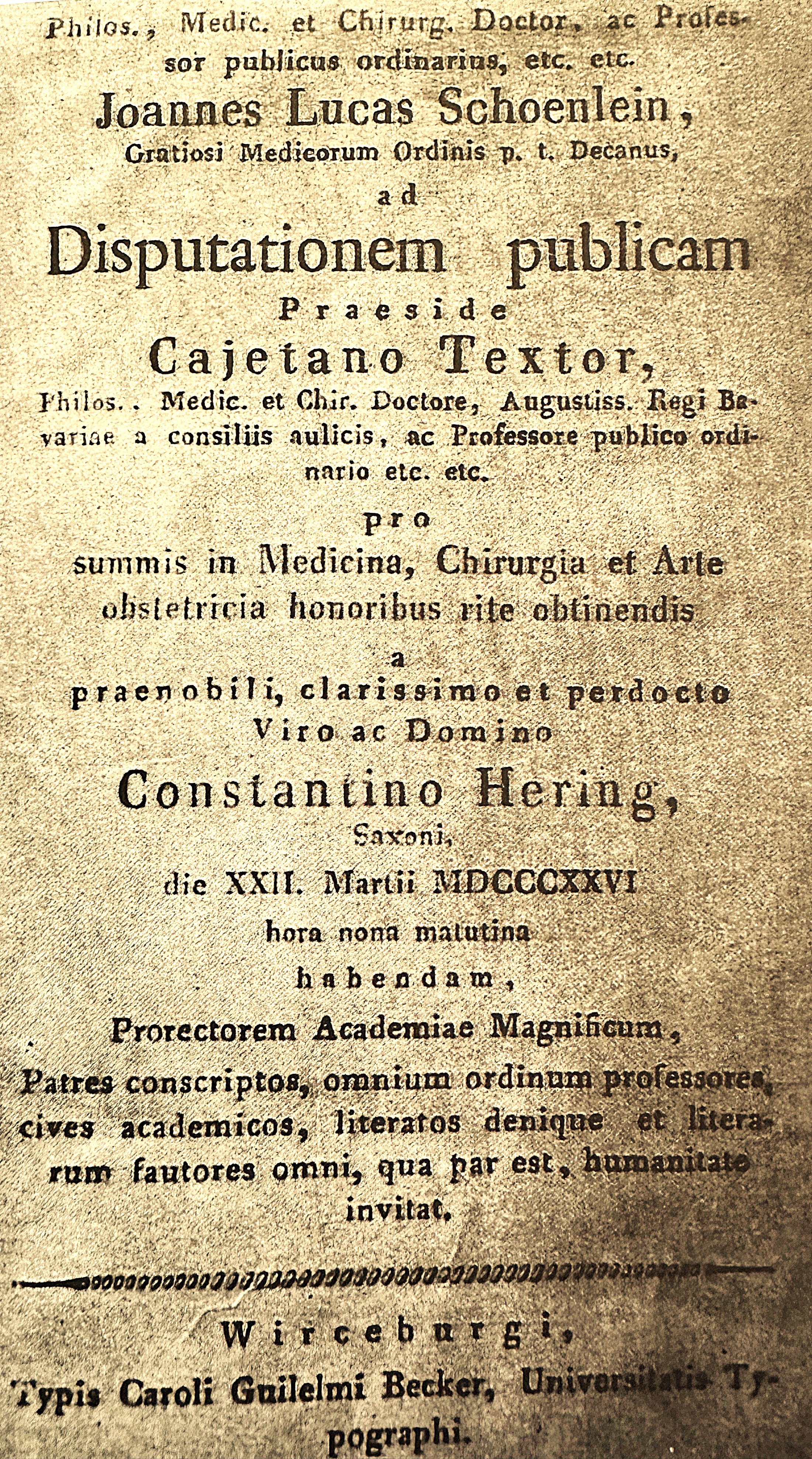
On Wednesday 22 March 1826, a rebellious medical student passed his medical examination before the examination board of the Würzburg Faculty and defended his dissertation on the subject of ‘Medicine of the Future’. The head of the institute was Prof. Dr Johann Lukas Schönlein, one of the founders of the scientific revolution in medicine in Germany, who later also became a teacher to Robert Remak, Ludwig Traube and Rudolf Virchow in Berlin.
The 26-year-old rebel was known as a supporter of homeopathy, which made life very difficult for him amongst his fellow students and earned him the disapproval of many professors. Nevertheless, he passed all his exams with the highest honours. It is said that Schönlein, who was regarded as a critic of homeopathy, questioned him gently about the homeopathic treatment of scarlet fever.
His courage and contrarian spirit led the young doctor of medicine on a long life’s journey, taking him from the Blochmann Institute in Dresden on expeditions to Suriname in South America, where he established a leprosy hospital and conducted intensive natural history research. Later, he became the founder of North American homeopathy in Philadelphia.
A life rich in tireless endeavours, wholly dedicated to the scientific and systematic development of homeopathy.
The remarkable vision of a medicine of the future, capable of uniting natural and humanistic scientific thinking across all medical disciplines, served as the guiding principle for Constantin Hering in further developing homeopathy. A vision that remains as relevant today as it was 200 years ago.
This approach embodies the Medical Humanities. An interdisciplinary approach for the holistic development of medicine.
With this position paper, we at the Constantin Hering Foundation® are delighted to commemorate, within the professional community, the visionary courage and unwavering commitment required to achieve this.
No comments
Sign in to leave a comment.
Sign in• 22.03.2026
Be the first to comment!